AI Integration and The Time Saved Paradox
Why saving time with AI doesn't make people happier—and what to do about it.

Jan 19, 2026
AI Doesn’t Fail Because It Doesn’t Work
AI often fails not because it’s ineffective, but because we misunderstand what “saving time” actually means. For years, I believed something that feels obvious:
“If you give people back time, they will be happy.”
After building and shipping AI-powered products across several business cases, I’m no longer sure that’s true.
Time Saved Is Not Neutral
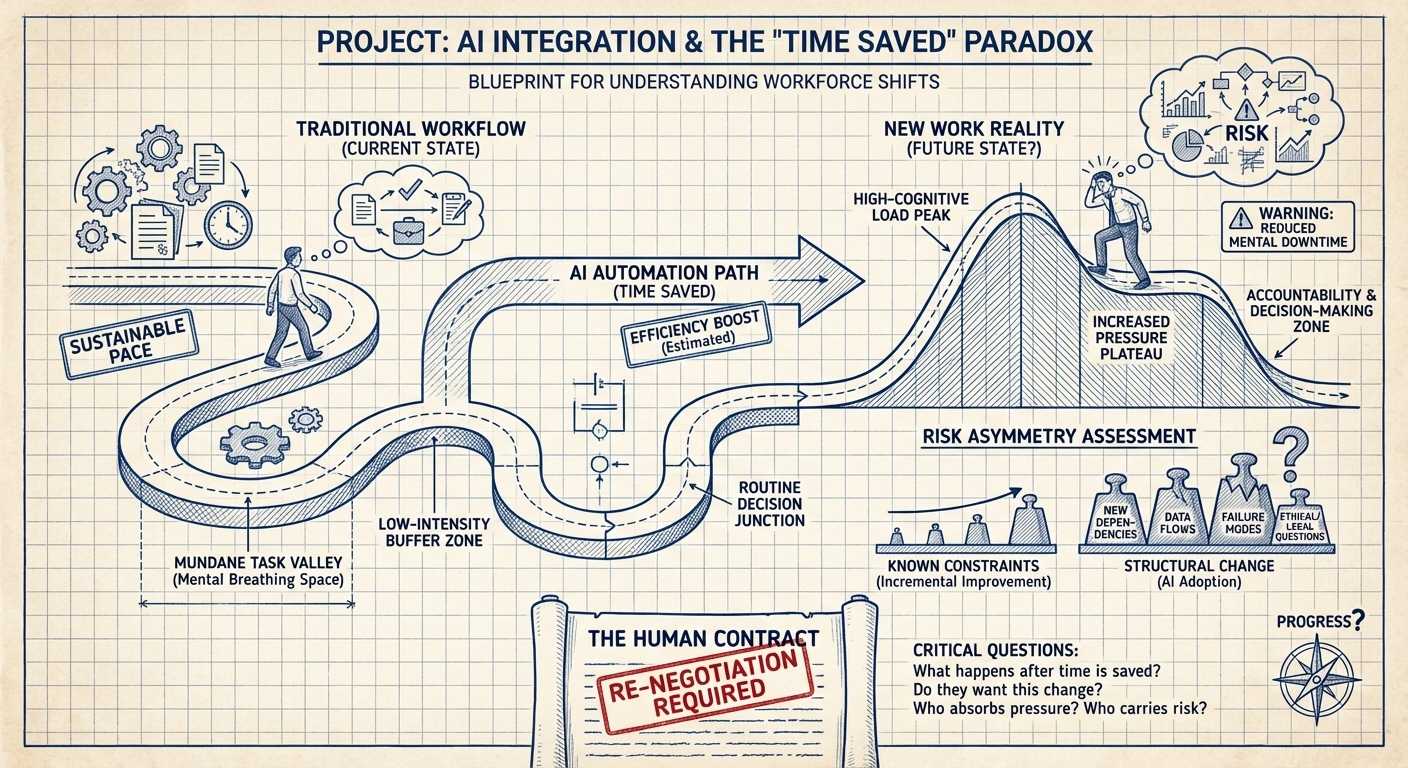
Here’s the uncomfortable insight: time saved is not neutral. It changes roles, expectations, pressure, and even identity at work. We often assume that mundane tasks are universally hated — that everyone wants to operate at 100% cognitive capacity, all day, every day.
In reality, many people, including white-collar professionals, need low-intensity tasks. These tasks act as mental breathing space. They reduce pressure. They make a long day sustainable. When AI removes those tasks, the job doesn’t just become more efficient. It becomes different.
What Actually Changes When AI Removes Work
Suddenly:
- The bar is higher
- Mistakes feel more costly
- The role drifts closer to decision-making and accountability
- The mental load increases — sometimes sharply
That’s not automatically progress. And it’s often not what people signed up for, junior or senior.
The Overlooked Problem: Risk Asymmetry
There’s another blind spot: risk asymmetry. If your business has worked well enough for 10 or 20 years, adopting AI isn’t a small optimization. It’s a structural change.
You introduce:
- New dependencies
- New data flows
- New failure modes
- New ethical, legal, and environmental questions
And crucially, you’re taking that risk before the entire system around you is ready. If your competitors are operating the same way you are — and the market isn’t collapsing tomorrow — what exactly forces you to jump first? Working harder, improving incrementally, and mastering known constraints can feel safer than redefining processes that go far beyond your job description.
Why So Many AI Projects Stall
This is why many AI initiatives stall — not because the technology is bad, but because the human contract was never re-negotiated.
So maybe the real question isn’t: “How much time can AI save?”
But instead:
- What happens to people after time is saved?
- Do they actually want that change?
- Who absorbs the new pressure?
- And who carries the risk when things go wrong?
I’m curious to hear from you:
- Where has AI genuinely helped in your work?
- Where has it quietly made things harder?
- What did you learn that you didn’t expect?
Let’s talk about the parts we usually skip.