Model routing
We benchmarked 13 LLMs across 470 tests in four languages, and 9 over 1,260 tests for cost and variance. Each task goes to the cheapest model that holds its accuracy: DeepSeek V3.2 reached 92.8% at 1/65th the cost of Claude Opus 4.5.
Our agentic workflows split a business process across specialised AI agents, each doing one job well, with a person in the loop wherever a mistake would cost money. The orchestration runs on Go services backed by PostgreSQL, and agents reach your systems through Model Context Protocol (MCP) servers.
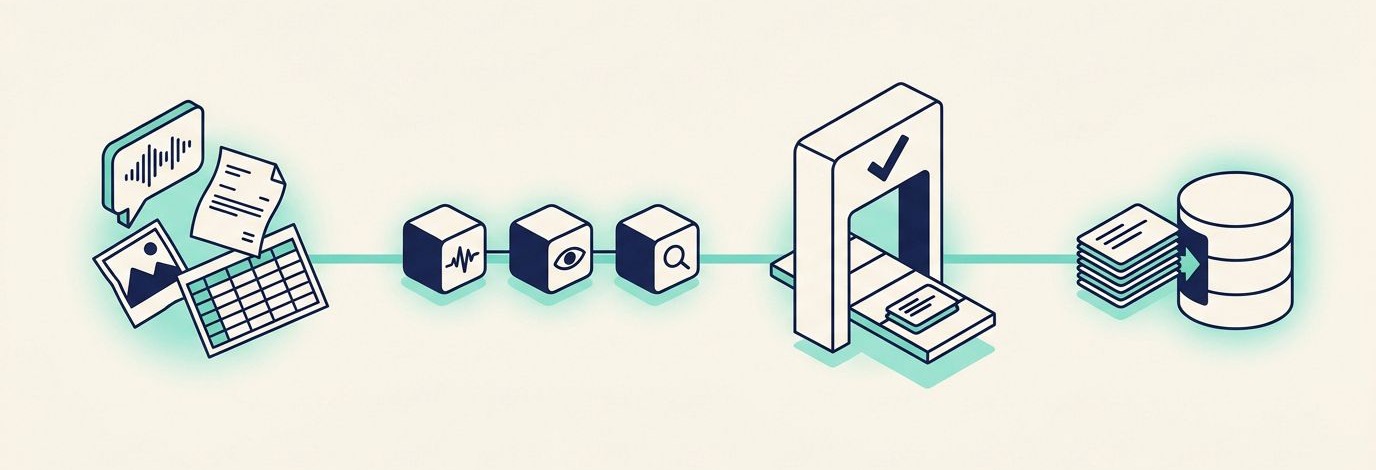
Voice notes, photos, PDFs and spreadsheets, as your customers and teams actually send them.
Multi-agent orchestration: one agent transcribes, another reads documents, another matches products to your catalog.
Business rules and confidence scores decide what goes straight through and what a person reviews first.
Structured data lands in your ERP or CRM through APIs and MCP servers.
Six capabilities, each measured on real workloads. Follow the links for the full numbers.
We benchmarked 13 LLMs across 470 tests in four languages, and 9 over 1,260 tests for cost and variance. Each task goes to the cheapest model that holds its accuracy: DeepSeek V3.2 reached 92.8% at 1/65th the cost of Claude Opus 4.5.
One vision model reads invoices, labels, payslips and handwritten schedules without templates. JSON recovery takes first-pass parsing from about 90% to over 99%. We ran it on an insurer's entire claims book: 13,000 documents, 96% of them photos.
We test speech models on the client's own audio before picking one. On 54 UAE WhatsApp voice orders mixing Gulf Arabic, English and Urdu, the best API model recovered 84% of ordered products and the best self-hosted model 71%.
Agents reach your systems through MCP servers we build in Go. One exposes 91 tools from a single server without exhausting the agent's context. Agents that write to production echo each change, show it, and can undo it in one step.
Retrieval combines semantic, structured and fuzzy search, then merges and ranks the results, so answers come from your data. The same approach deduplicates messy catalogs, like a 30,000-entry wine list where five entries turned out to be three wines.
Staging and production are defined in Terraform and run on Kubernetes. We moved Whisper and diarization off a $5,000-a-month always-on GPU to pay-per-use with scale-to-zero, and we plan failover across regions and providers.
We measure what matters in production: reliability across runs, cost per accuracy point, and real-world variance, not just average benchmark scores. Every AI decision includes an explanation and confidence score, so your team always understands the reasoning.
Every system we build has a declared data path. Sensitive data stays on open-source models running on your servers or on dedicated infrastructure we manage. When an external model is the better tool, we only call providers with zero data retention, enforced on every request.
See this in practice: how we build self-hosted AI meeting notes
Our solutions connect to the tools your teams already use, with no rip-and-replace. API-first architecture means deployment does not disrupt existing workflows.
We run Kubernetes in production, and we open-sourced our full 22-hour course to teach it: 11 hands-on sessions, a real app on a local cluster, Terraform to GKE, secrets and CI/CD. Free under CC BY-NC.
We'll walk you through the architecture and show you how it handles your specific data challenges.


