Who Actually Wins When AI Saves an Hour of Work?
Companies and employees both have the same AI. Who captures the value?

Jan 21, 2026
I keep coming back to the question of who actually captures the value of AI.
We’re at a strange point where both companies and employees have access to the same underlying technology.
That hasn’t really happened before — at least not at this scale.
A New Kind of Symmetry
AI is being deployed inside organizations, yet usage is often uneven
(you can read more about this “shadow AI” in studies from BCG, IDC, etc).
At the same time, people use AI on their own terms — sometimes quietly.
This coexistence feels less like a transition phase and more like a signal.
If both sides can use the tool, value capture becomes ambiguous.
Two Interpretations of the Same “Saved Hour”
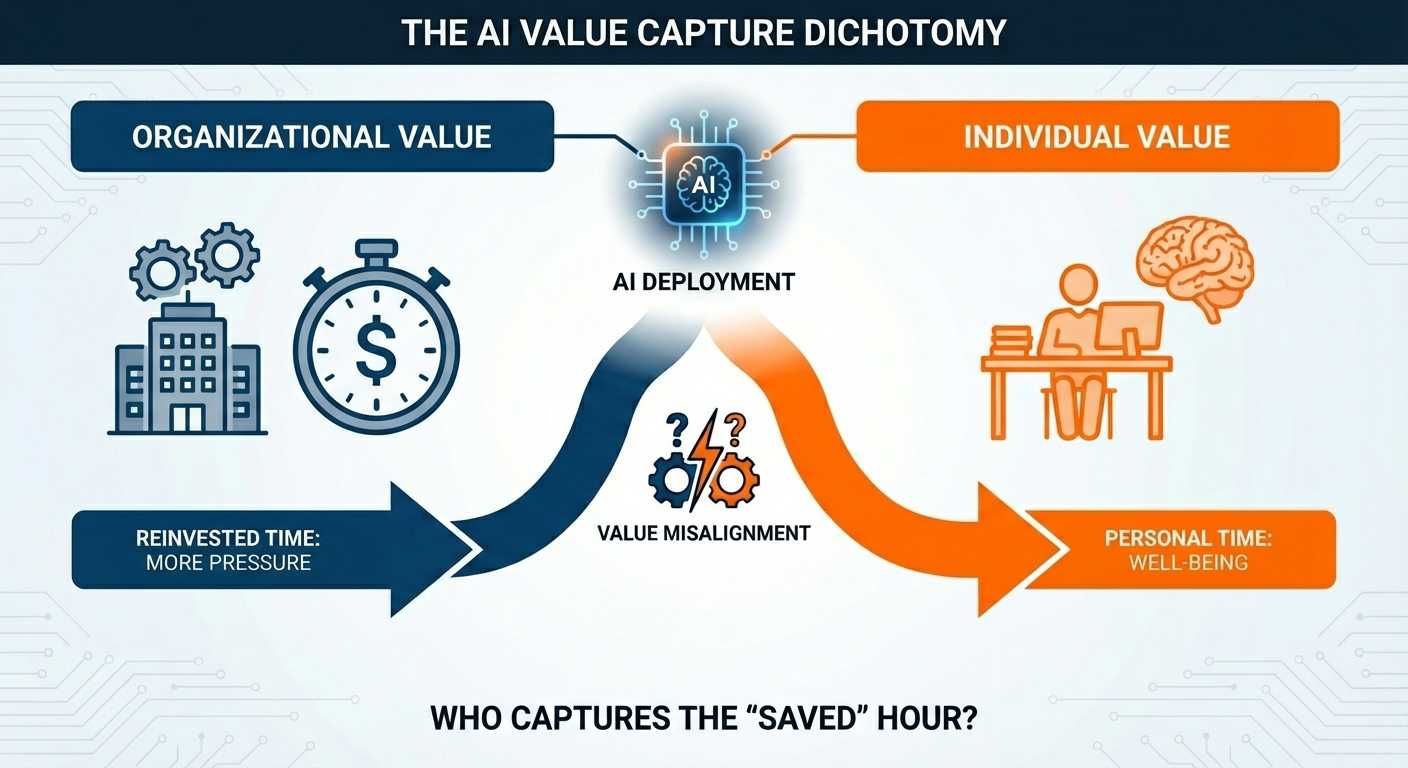
When an employee uses company-provided AI, the value is often captured at the organizational level.
Output is faster.
Workflows are smoother.
Costs go down.
In many cases, the implicit expectation is that the time saved will be reinvested into more work, more scope, and more throughput.
Sometimes that also means more pressure, more demanding tasks, and fewer mundane, low-intensity tasks left to do.
From the company’s perspective, that makes sense.
But from the employee’s side, the picture is different.
AI as Personal Leverage
Employees can also use AI for their own benefit.
They use it to reduce workload, free time during peak moments, or simply avoid work spilling into evenings.
In that context, AI is not just a productivity tool.
It’s a way to lower cognitive load
and regain control over when and how work gets done.
That value is immediate and personal.
Where Tension Appears
This is where tension can appear.
The same hour “saved” by AI can be interpreted in two very different ways.
Neither interpretation is wrong.
But they don’t align by default.
That misalignment may explain why AI adoption often becomes selective.
People are not resistant.
Not hostile.
Just cautious.
They choose when to use AI, how visible that use is, and in which contexts it’s applied.
In practice, they manage where the value goes.
The Real AI Adoption Challenge
So maybe the real challenge isn’t deploying better tools or redesigning workflows.
Maybe it’s clarifying the implicit contract around AI.
What happens to the value it creates.
Who captures it first.
How gains are shared when access to the technology is symmetrical.
When AI Adoption Actually Works
Interestingly, AI seems to stick best where this ambiguity doesn’t exist.
When time crunch is real
and inefficiency hurts immediately,
reclaimed time has a clear and shared value.
Elsewhere, the question stays open.
And that may be where many AI adoption efforts quietly succeed or fail.
#shadowAI #adoption #LLM