Why Sales Reps Don't Use the CRM, and What Actually Fixes It
It isn't laziness and it isn't a training gap. The people with the freshest information are the ones least able to stop and type it in. Fix the friction and adoption follows.

Jul 4, 2026
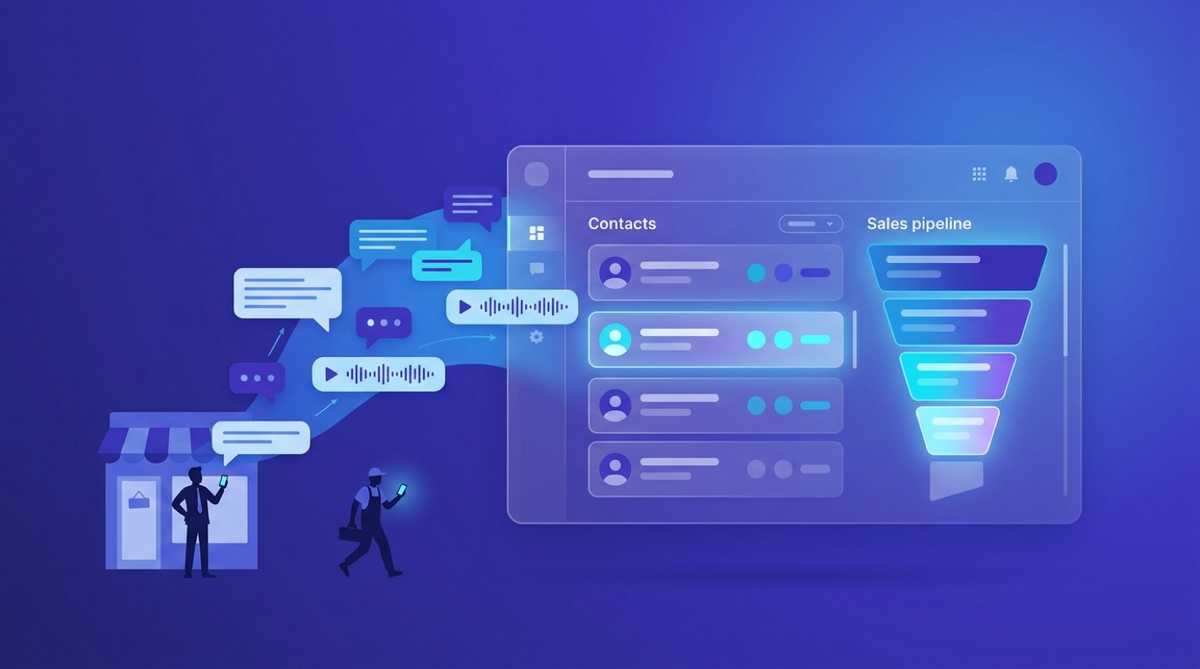
Every sales leader has run the same play. Roll out the CRM (brand-new, expensive), train the team, set the expectation that every interaction gets logged the moment it happens. A few weeks in, the pipeline is half-updated, the "last contacted" dates are stale, and the forecast rests on data nobody fully trusts. The usual conclusion is that the reps need more discipline.
Except they aren't the problem, and the next training day won't change the outcome. To fix CRM adoption you have to be honest about why it stalls in the first place.
Is it really a discipline problem?
No. It's a timing problem. The people with the most valuable information — who they just met, what moved, who the real decision maker is now — are the people with the least room to record it. And it's worth remembering that a CRM was historically built as a tool for management and control, not as a closing aid for the reps themselves. A rep walks out of a meeting with a head full of still-rough, half-formed detail and a drive to the next appointment already underway. Opening the CRM, finding the account, structuring their thoughts, and filling a dozen fields competes with that drive, and the drive wins.
The update doesn't get missed because the rep doesn't care. It gets missed because the moment it's worth capturing is the moment there's no time — or mental energy — to capture it.
So why do mandates and training fail?
Because they treat a friction problem as a willingness problem. Mandates, leaderboards, "just log it after every call" — they all assume the rep would update the CRM if only they wanted to a bit more. So they push harder on motivation and leave the actual cost of an update untouched.
That cost is the whole game. If logging a visit means stopping, switching apps, and typing structured data into a form — maybe on a laptop balanced on your knees, tethered to a phone's 5G — no amount of training or pep talk makes it happen reliably in the field. The friction is fixed; the willpower is variable; the friction wins every time.
Where does the data actually live?
In the rep's head, for a few hours after the meeting. That's the window. It's rich — full of the nuance a form never captures, and not always neatly structured — and it's short. By "tonight," when the rep finally has a laptop and ten quiet minutes, half of it has already faded into "had a good chat, will follow up."
Any CRM strategy that depends on reps reconstructing their day at a desk, at best, loses three-quarters of the interesting detail — and at worst distorts the record completely. The data you actually want is the data captured in the moment, on the go, while it's still sharp.
So how do you actually fix adoption?
Make capturing an update cost almost nothing, in the place the work already happens. Not a better form. Not another reminder. A capture path that fits a rep between meetings: a quick message or a voice note from the phone already in their hand, turned into a clean CRM record they confirm with one tap.
When the cost of an update drops to the cost of sending a message — a voice note, even — the update happens: not because the team finally got disciplined, but because you stopped asking them to do data entry they were never going to do. We wrote about exactly how that capture works: the rep messages, AI drafts the record, and a human confirms before anything commits.
The point
Stop trying to make reps love the CRM. Make the CRM cost them nothing to feed. Adoption isn't a motivation you install with training; it's what happens on its own once capture fits the way the field actually works. And once the CRM is finally full, the reps won't be able to ignore the obvious upside of a CRM that actually reflects reality.
If your team won't fill the CRM you pay for, the fix is the capture path, not the people — that's exactly what Voice to CRM delivers. Let's talk — we'll show you what frictionless capture looks like on your stack.