How to Get Your Field Team to Actually Fill the CRM You Paid For
A CRM is only as good as what your field team puts into it. Here's the approach we've seen work: let reps capture updates straight from WhatsApp and voice notes in the moment, with AI drafting the record and a human confirming before anything commits.

Jun 27, 2026
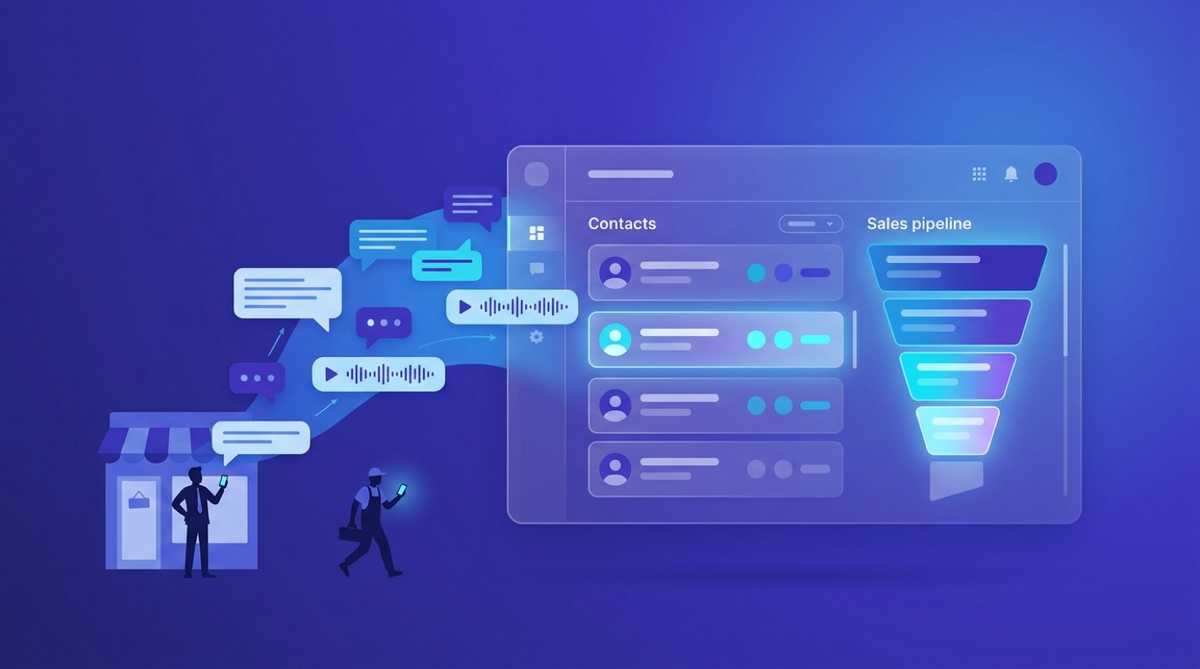
You invested in a serious CRM — Salesforce, HubSpot, Dynamics. The forecast, the pipeline view, the reporting all rest on one assumption: that the data inside is current. And the updates that keep it current live in one place that's hard to reach — your field team's heads, in the minutes right after a meeting.
That's when the information is richest: who they just saw, what moved, who the real decision maker is now, the next step. It's also when there's the least time to log it. Opening the CRM, finding the contact, and filling a dozen fields competes with the drive to the next appointment, and the appointment usually wins. The update waits for "tonight," and by tonight some of it has faded.
This isn't a discipline problem, and another training day won't move the needle. It's a capture problem — and capture is something you can design around. Here's the approach we've seen work in the field.
Why does CRM adoption stall?
Because the people with the freshest information are the ones least able to stop and type it in. A field rep, a technician, an account manager between meetings has the update in their head the second they walk out. What they don't have is a laptop, ten quiet minutes, or a reason to pick data entry over the next customer.
The richest moment for CRM data is the debrief on the go, right after a meeting. The window there is measured in seconds, not minutes, and any workflow that needs more than that loses. So the move isn't to push harder toward the form. It's to meet the team where the work already happens — on their phone, in the moment.
What if updating the CRM took one message from the field?
Then it would actually happen, because the cost of an update drops to the cost of sending a message — something the rep already does between every meeting.
Picture the rep walking out and debriefing on the spot. Instead of promising to "update Salesforce tonight," they fire off a WhatsApp message, or hold the mic for eight seconds:
"Just saw Marie at Decathlon Bordeaux. They want the Q3 proposal by Friday, budget's around forty grand, she's the decision maker now, not Paul. Follow up Thursday."
A few seconds later, a clean draft comes back:
Update ready — confirm?
- Contact: Marie Lefevre (Decathlon Bordeaux) — set as decision maker
- Deal: Q3 proposal, €40,000, stage moved to Proposal
- Follow-up: Thursday
One tap, and the update lands while it's still fresh — captured from the field, in the app the rep already has open. The CRM stops competing with the job and starts riding along with it.
How does a WhatsApp message become a clean CRM record?
The message goes through a reasoning step that extracts structure, then a typed tool layer that performs the write — and a human confirms before anything commits. We've described the full pattern before; here's how it maps onto a CRM.
It's three moves:
- Reason and extract. The model reads the message (or the voice transcript) and fills a known schema: which contact, which deal, which stage, what amount, what follow-up. It produces a structured proposal against your CRM's real objects, looking contacts and accounts up rather than trusting the spelling in a transcript.
- Resolve identity first. The sender's number is matched to a user, their team, and their permissions before anything runs. The model only ever sees the accounts that person is allowed to touch, so it can't update the wrong company because it can't even see it.
- Write through MCP. The commit happens through a typed tool layer (the same MCP server that runs our own sales, invoicing, and inventory), so a write can only take a shape the CRM actually accepts.
The unglamorous part — ordering corrections so "make it forty, actually forty-five" lands in sequence, never creating the same deal twice, retrying on a network blip — is the plumbing that makes it dependable at a sales team's volume.
Won't the AI put the wrong thing in my CRM?
Not if it never writes on its own. Extraction is never perfect, so the AI doesn't get the last word — the rep does. Every write runs as a dry-run first: the model proposes, the system shows exactly what would change in plain language, and the rep taps Confirm. Nothing reaches the CRM until that tap.
That keeps the data trustworthy for almost no effort. The AI does the typing the rep won't, and the human spends their judgment in the one place it counts — approving the record. It's the detail that matters at volume: even 98% extraction accuracy isn't enough on its own, and a one-second glance at a preview is what keeps the rare miss from landing as a line of CRM truth.
Does this hold up in the field?
It already does — including the messiest input there is: voice, on the move, in more than one language. We've run this kind of capture on real voice notes from people nowhere near a desk, including mixed Arabic and English orders from a busy UAE grocery floor. Typos, half-sentences, background noise, mid-thought corrections — the human confirmation absorbs whatever the transcription gets wrong.
The same flow that captures an order captures a CRM update: a contact met, a deal moved forward, a risk flagged, a next step set, all structured from a thirty-second message between meetings.
The point
You probably don't need a new CRM. You need the one you already own to fit the way your field team actually works, so the data that makes it valuable flows in on its own. The platform was never the missing piece. Frictionless capture from the field is.
Give the team a number they can message and a draft they can confirm, and the CRM you already pay for starts earning its price.
This is the engine behind Voice to CRM and Reflekt CRM's WhatsApp and voice capture, built on MCP servers we run in production. If you want more out of the CRM you already pay for, let's talk — we'll map your CRM's objects to a WhatsApp capture flow and show you a working demo.