A California industrial equipment and field-service company · Industrial equipment & field service · California, USA
Replacing a shipping workbook with a platform, in production in a day
A California company that installs and services industrial manufacturing equipment ran its shipping on one shared Excel workbook. We turned that workbook into a web platform and had it in production with their Microsoft sign-in the day after we received the file.
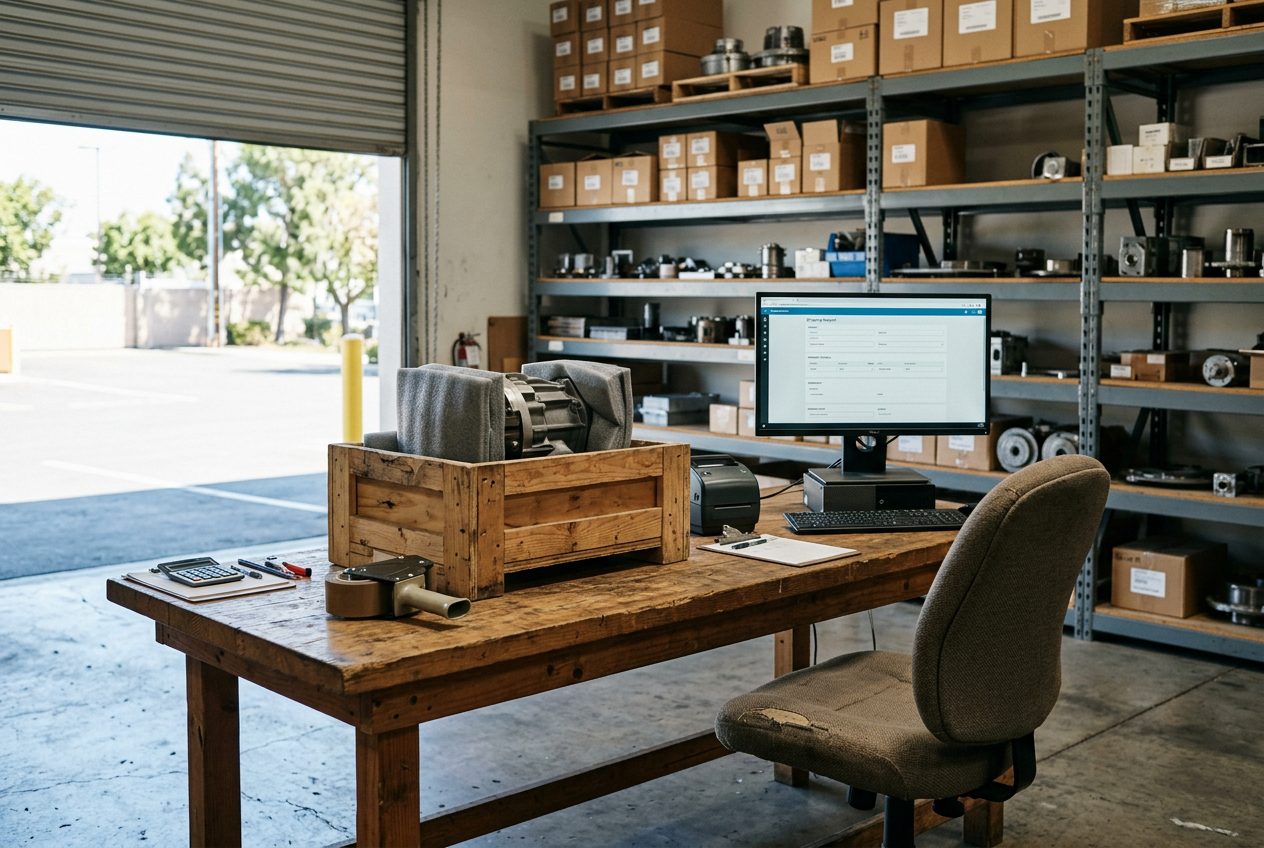
A California company that sells, installs and repairs industrial manufacturing equipment shipped parts and machines to its customers from a shared Excel workbook. We replaced it with a web platform: a shipping request picks the customer and everything about them resolves on its own, one record prints both the service report and the packing slip, and a workflow enforces the rules the paper process could only hope for. Staging was up the day after we received the workbook, and production followed that same evening.
The challenge
Every shipment started as a copy of a form tab inside one shared workbook. A technician or an office manager filled in the customer, the machine, the fault, the repair and what went in the box, then printed two documents from two ranges on the same sheet.
The workbook had grown by hand for years. Two unrelated tables shared rows by accident of layout, prose and phone numbers sat in the same columns as shipping items, and codes were prefixed with an underscore to stop Excel reformatting them. Anyone reading it naively would import fifty items where there were fourteen.
Nothing was enforced. A package could be marked shipped without a tracking number, a request could go out without written authorization, and freight figures (weight, volume, density, freight class) were worked out by hand against a printed lookup table every time.
Our approach
We treated the workbook as the specification. Its structure told us what one shipping request is, and its quirks told us what the import had to survive, so every column is read by its header text and every block has to look like itself before it is trusted.
Small packages and freight are separate flows, because they are shaped differently: freight moves between the company's own sites in both directions, and the billing term follows from the route rather than being typed. Each crate is a record with its own dimensions and weight, and the carrier figures are calculated live as the crate table fills in.
One record produces both printed documents: the internal service report and the packing slip that goes in the box, with no diagnosis or pricing on it. Requests move through clear stages, and a stage cannot be completed without what it needs, such as a tracking number to ship or an arrival date to close.
The team signs in with their existing Microsoft accounts, and a Slack message lands when a request is submitted. Iteration rounds from the team have shipped the same evening they were asked for.
Results
1 day
from receiving the workbook to production, with Microsoft sign-in
2 documents
service report and packing slip, printed from one record
Same evening
turnaround on the team's iteration requests
Stack
Have a spreadsheet or a legacy system that's holding you back?
Send us a sample. We'll show you what we can do with it.


